What Actually Goes Wrong With Concealed Cisterns
Concealed cisterns are mechanically simple - a fill valve, a flush valve, and a dual-flush mechanism. The components that fail are the same ones that fail on any cistern: fill valves that run continuously, flush valves that drip, and float mechanisms that stick. In an exposed close-coupled toilet, any of these faults takes under an hour to diagnose and fix. The cistern lid comes off, the fault is visible, the part costs under £15 at any plumbing supplier.
In a concealed cistern installation, the same fault has the same cause and the same fix - but the access situation changes everything.
The three installation configurations, in order of maintenance difficulty:
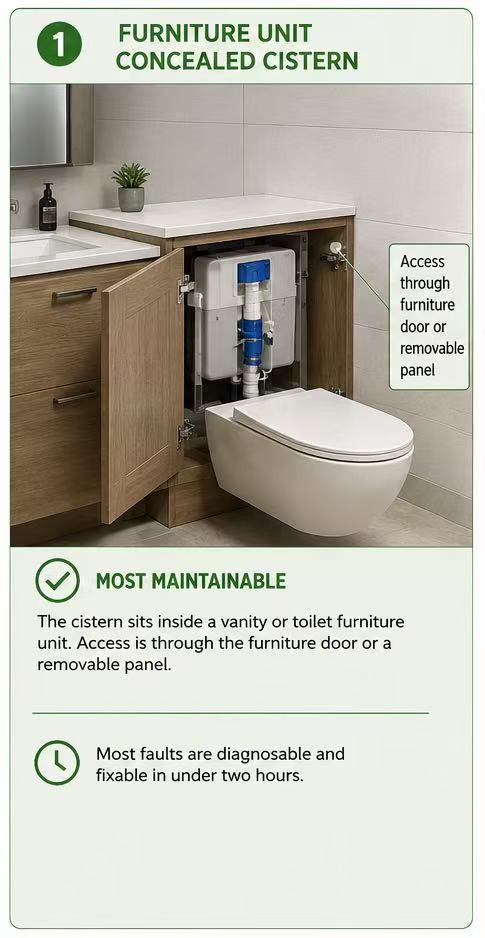
Furniture unit concealed cistern The cistern sits inside a vanity or toilet furniture unit. Access is through the furniture door or a removable panel. This is the most maintainable BTW configuration - a plumber can reach the cistern without touching the wall finish. Most faults are diagnosable and fixable in under two hours.
Stud wall with access panel The cistern is mounted on a frame inside a stud wall partition, with a flush plate on the front face and an access panel - typically a removable tile or panel section - on the side or top. Access requires locating and removing the panel, which in well-specified installations is straightforward. In poorly specified installations, the access panel was either not included or was tiled over during the bathroom fit-out. The latter turns a minor repair into a significant one.

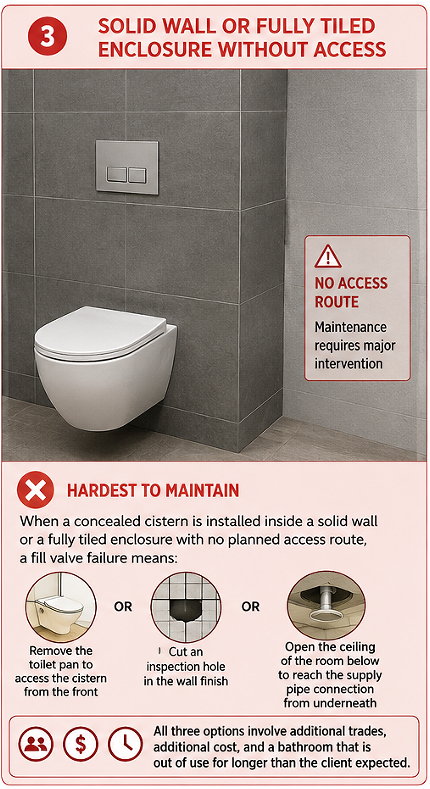
Solid wall or fully tiled enclosure without access This is where maintenance complaints originate. When a concealed cistern is installed inside a solid wall or a fully tiled enclosure with no planned access route, a fill valve failure means either removing the toilet pan to access the cistern from the front, cutting an inspection hole in the wall finish, or - in multi-storey properties - opening the ceiling of the room below to reach the supply pipe connection from underneath. All three options involve additional trades, additional cost, and a bathroom that is out of use for longer than the client expected.
The Access Panel Question - What to Specify Before Installation
The single most effective way to prevent concealed cistern maintenance problems is to specify the access route before the wall goes up, not after the tiles go down.
For trade buyers and contractors, this means asking three questions at the specification stage:
1. Is an access panel included in the cistern frame package? Most concealed cistern frames designed for stud wall installation include an access provision - either a side panel location or a top-access configuration. Confirm this is specified and that the access route is documented in the installation drawings before the frame goes in. A frame installed without a documented access route relies on whoever does the tiling to leave an accessible panel, which does not always happen.
2. Is the access route compatible with the wall finish? A tile access panel in a fully tiled bathroom requires either a removable tile section held with silicone rather than grout, or a proprietary lift-off tile panel. Both work. Neither works if the tiler grouted everything solid without being told about the access requirement. This coordination between the plumbing installation and the tiling sequence is where the majority of no-access problems originate - not from a design failure but from a site coordination failure.
3. Is the supply pipe connection accessible without removing the pan? The water supply connection to the cistern is the most common leak point. In most stud wall installations, this connection is accessible through the access panel. In some configurations - particularly where the supply pipe runs through the floor rather than the wall - the connection point sits below the pan fixing, which means pan removal is required to reach it. Identify this at the specification stage, not when the leak appears.
What This Means for Project Procurement at Volume
For a contractor or procurement team specifying BTW toilets across 20, 50, or 100 rooms, the access panel question is not a detail - it is a maintenance cost decision that runs for the lifetime of the installation.
A 60-room hotel property on one BTW model, fully tiled with no planned access route, has 60 cisterns that are effectively inaccessible without demolition work. Over a ten-year maintenance contract, the probability that at least some of those cisterns will require attention is high. The cost difference between a fifteen-minute fill valve replacement through an access panel and a two-day wall repair job is material when multiplied across a property.
The specification decisions that prevent this:
Confirm access panel provision with the cistern frame supplier before ordering
Include access panel location in the M&E drawings issued to the tiling contractor
Specify that access panels are to be finished with removable silicone-set tiles or proprietary lift-off panels, not grouted
For multi-storey properties, confirm the supply pipe connection point relative to the floor structure before the frame installation sequence is set
None of these steps adds significant cost to the project. All of them add significant cost if they are skipped.
Fill Valve Standardisation - The Other Maintenance Decision
The second maintenance question for project procurement is fill valve standardisation. A concealed cistern fill valve that fails after three years should be replaceable by a maintenance technician with a part sourced locally, not a proprietary component ordered from the original manufacturer with a two-week lead time.
For project buyers specifying BTW toilets at volume, this means confirming two things before the purchase order:
Is the fill valve an industry-standard replaceable component?
Standard fill valves - the Geberit type 380 or equivalent - are available from any plumbing merchant in the UK and Europe. Proprietary fill valves require ordering from the original supplier, often at a significant price premium and with extended lead times. For a property manager running 60 rooms on one cistern model, fill valve standardisation is a maintenance budget line item worth confirming at the procurement stage.
Does the concealed cistern frame provide access to the fill valve without full cistern removal?
n most standard stud wall frame installations, the fill valve is accessible through the flush plate opening or the side access panel. In some configurations, fill valve replacement requires removing the flush plate, the cistern, and occasionally the pan. Confirm the service sequence with the cistern frame supplier before specifying.
A Practical Maintenance Checklist for BTW Toilet Specification
Before committing to a BTW toilet specification for a project, confirm the following:
|
Item |
Question to ask |
|
Access panel |
Is a side or top access panel included in the cistern frame? |
|
Wall finish coordination |
Is the access panel location documented in drawings issued to the tiling contractor? |
|
Access panel finish |
Are removable tiles or a proprietary lift-off panel specified at the access location? |
|
Supply pipe location |
Is the water supply connection accessible through the access panel, or does it require pan removal? |
|
Fill valve standard |
Is the fill valve an industry-standard replaceable component or proprietary? |
|
Multi-storey access |
In properties with rooms below, is the supply pipe connection accessible from above? |
This checklist applies regardless of the toilet brand or price point. A Duravit BTW pan installed without a planned access route will generate the same maintenance problem as any other BTW pan installed the same way.
A Note on the FTZ-6602X
If you are specifying a rimless back to wall toilet for a UK or European project - residential development, hotel refurbishment, or apartment renovation - the FTZ-6602X from HFY Bath is compatible with standard concealed cistern frames including Geberit and equivalent stud wall systems. CE certified, slow-close seat included, P-trap 180mm horizontal outlet, 520mm projection. MOQ 20 units, 35–45 day lead time, OEM available.
The maintenance access questions covered in this guide apply to the cistern frame and wall specification, not to the bowl itself. The FTZ-6602X bowl is a standard pan with no proprietary connection requirements - compatible with industry-standard fill valves and accessible through any correctly specified access panel configuration.
Tell us your project market, room count, and timeline. We respond within 24 hours with pricing and CE documentation.
hfybath.com · Tangshan, China · CE / ISO 9001
https://www.hfybath.com/toilet/back-to-wall-toilet/rimless-back-to-wall-toilet-wholesale.html