What Hard Water Actually Does to a Toilet
Most water across the Gulf is hard - rich in dissolved calcium and magnesium. When that water sits or evaporates on a surface, the minerals are left behind and bond to whatever they touch. In a toilet, that happens fastest where water lingers: at the waterline, under the rim jets, and anywhere the bowl stays damp.
Over time these deposits, known as limescale, build into a chalky crust that ordinary cleaners cannot dissolve. Left untreated, hard-water minerals can stain a bowl so deeply that the discolouration becomes effectively permanent - the toilet looks dirty even right after it has been cleaned. The same deposits also collect in the rim jets, which can gradually weaken the flush.
For a homeowner this is an annoyance. For a hotel, a residential tower or a public facility, it is a maintenance cost and a reputation problem that repeats across every bathroom in the building.
The buyer takeaway: in a hard-water market, the surface quality of the toilet is not a cosmetic detail. It is the single biggest factor in how the product looks, performs and is perceived three years after installation.
Why Two "Identical" Toilets Age Differently
1. Body density and firing temperature
A ceramic toilet is only as strong as the body underneath the glaze. A denser body, fired at a higher temperature, is closer to fully vitrified - almost non-absorbent even before it is glazed. That density is what resists hairline crazing, warping and the slow water penetration that leads to staining and structural weakness in softer, under-fired ceramics. As a rule, the higher and more evenly a body is fired, the better it stands up to hard-water conditions.
2. Glaze porosity
The glaze is the toilet's skin. A glossy, low-porosity glaze gives minerals fewer places to grip, so limescale wipes away instead of bonding in. A rougher or more porous glaze - common on cheaper imports - traps deposits and organic matter in microscopic pits, which is why some bowls start to look permanently grey or brown no matter how often they are scrubbed. Aggressive scrubbing then makes it worse, because micro-scratches in a weak glaze create even more sites for future staining.
3. Firing consistency across the run
This one matters specifically to project buyers. A factory that controls its firing curve produces units that are uniform in colour and dimension from the first carton to the last. A factory that does not will ship a pallet where the glaze tone drifts and the bowls do not all sit the same - a problem you only discover during installation, when it is most expensive to fix.
What to Check Before You Order
You do not need to be a ceramics engineer to buy well. A short, specific checklist filters out most of the products that will generate complaints in a hard-water market.
1.Ask about the body and firing. Is it high-fired vitreous ceramic? A vitrified body is the foundation of hard-water durability.
2.Ask about water absorption. Lower water-absorption ceramics resist staining and mineral penetration far better. A serious manufacturer can speak to this.
3.Look at - and feel - the glaze. On a sample, the surface should be glossy and smooth to the touch, with no pinholes or gritty patches. Run a finger over the trapway entrance and rim, not just the visible bowl.
4.Confirm a fully glazed trapway. A smooth, glazed trapway helps waste and water move through cleanly and gives scale less to cling to.
5.Ask how consistency is controlled. Tunnel-kiln firing with controlled, repeatable curves is what keeps a 500-unit order uniform. Ask the question directly.
6.Always approve a physical sample. Photos hide glaze quality. Sign off a real unit - and ideally a third-party pre-shipment inspection - before the full run ships.
Durability and Water Saving Go Together
In a region where water is scarce and increasingly regulated, the flush matters as much as the finish. A well-engineered washdown system delivers an effective flush at a lower water volume, which is exactly what water-efficiency rules in the Gulf are pushing toward - and what the Water Efficiency Label (WEL) recognises in Saudi Arabia.
There is a quality link here that is easy to miss: a smooth, fully glazed trapway and a clean bowl surface help a lower-volume flush clear effectively, because there is less friction and less residue for water to fight against. In other words, the same glaze quality that resists hard-water staining also supports the water-saving performance buyers increasingly have to specify. Quality and efficiency are not a trade-off - on a well-made toilet they reinforce each other.
How This Shows Up in the JT2079

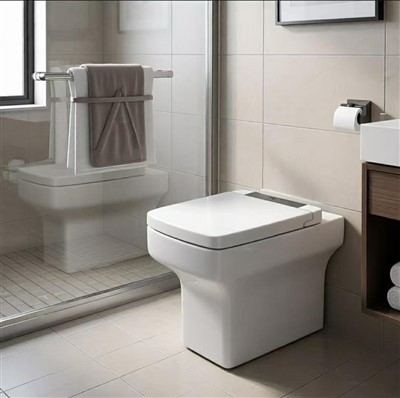
Everything above is the standard we build the JT2079 washdown one-piece toilet to. The body is high-fired vitreous ceramic; the glaze is glossy and low-porosity to resist limescale and stay easy to clean; and firing runs on tunnel kilns with controlled, repeatable curves so colour and dimensions stay consistent across large project orders.
The washdown system is tuned for an effective flush at lower water volume, supporting WEL water-saving requirements in the Gulf - and every unit is flush-, leak- and dimension-checked before packing, with third-party inspection welcomed.
Frequently Asked Questions
FAQ
Q: Does hard water damage all toilets equally?
A: No. Hard water affects every toilet, but a dense, high-fired vitreous body with a glossy, low-porosity glaze resists staining and scale far better than a softer, more porous ceramic. The difference becomes obvious after a year or two in service in a hard-water area.
Q: Can limescale stains be removed once they form?
A: Light deposits can be dissolved with mild acidic cleaners and dwell time. But on a porous or scratched glaze, minerals penetrate the surface and the discolouration can become effectively permanent - which is why glaze quality at the point of purchase matters more than any cleaning routine.
Q: Is a washdown toilet suitable for hard-water commercial bathrooms?
A: Yes. A washdown system with a smooth, fully glazed trapway clears effectively at lower water volume and gives scale fewer places to build up, which makes it a practical choice for high-traffic commercial bathrooms in the Gulf.
Q: What should I ask a manufacturer to confirm durability?
A: Ask whether the body is high-fired vitreous ceramic, how low the water absorption is, whether the trapway is fully glazed, and how firing consistency is controlled across a production run. Then approve a physical sample before ordering in bulk.
Q: How does glaze quality relate to water saving?
A: A smooth, fully glazed bowl and trapway reduce friction and residue, helping a lower-volume flush clear effectively. So the same glaze quality that resists hard-water staining also supports the water-efficiency performance increasingly required in the Gulf.
Related Reading
JT2079 Gold-Trim One Piece Washdown Toilet - product details and specifications