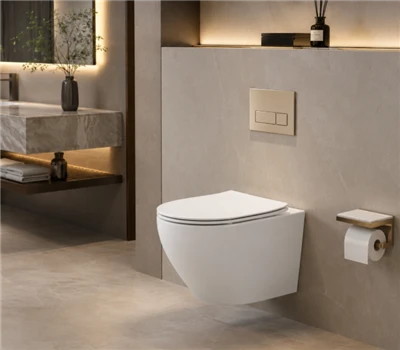
The Boutique Hotel Bathroom Fixture Brief
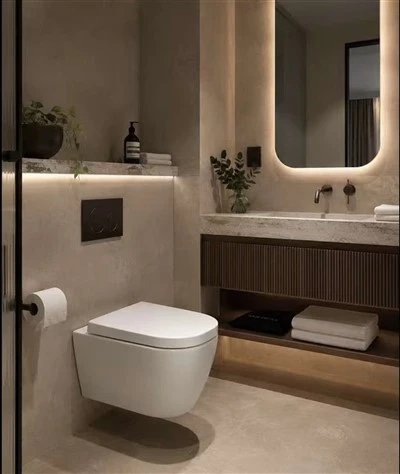
Most boutique hotel bathroom specifications in the 30–150 room range share the same core fixture set. The wall-hung configuration is increasingly standard for design-led properties because it frees the floor plane, simplifies cleaning, and reads as contemporary in marketing photography regardless of the fixture brand.
A standard single-bathroom configuration for a boutique hotel room:
|
Fixture |
Specification notes |
|
Wall-hung toilet bowl |
P-trap horizontal outlet, washdown flush, dual flush, slow-close seat |
|
Concealed cistern + carrier frame |
Geberit DuoFix or equivalent, 2x4 or 2x6 pre-wall |
|
Flush actuator plate |
Chrome or brushed finish to match room hardware |
|
Wall-mounted or countertop basin |
Drain type to match existing plumbing chase |
|
Basin mixer tap |
Typically specified separately or as part of bathroom package |
|
Grab bar (optional) |
Increasingly specified in accessible rooms and general guest rooms |
For a 60-room property, that means 60 toilet bowls, 60 cistern carrier systems, and 60 basins as the ceramic and hardware core. The sourcing decisions on the toilet bowl specifically - brand, certification, flush specification, seat inclusion - determine a meaningful portion of the per-room FF&E cost.
Three Decisions That Drive Boutique Hotel Toilet Procurement
1. Brand specification vs. performance specification
Some boutique hotel projects carry a brand requirement into the FF&E brief. An investor deck that names Duravit, a franchise standard that lists approved suppliers, or an interior designer with a long-standing trade account - these are real constraints that close the sourcing decision before it opens.
Most boutique hotel projects do not have a named brand requirement. The brief says "wall-hung, contemporary, CE certified, white ceramic." That brief is met by multiple sourcing tiers. The procurement team's job is to identify which tier delivers the required specification at the best landed cost per room, with the compliance documentation and quality consistency a project installation requires.
If your brief names a brand, source that brand. If your brief names a specification, run the sourcing process properly before defaulting to the brand tier.
Seat inclusion and per-room landed cost
The ME by Starck rimless wall-mounted toilet measures 370 × 570mm and comes with Duravit's patented Durafix attachment system for concealed installation. What it does not come with is a seat. Duravit Starck 3 wall-mounted toilet bowls retail at $458–$705 with seat sold separately.
At €100–€200 per seat added to a €500–€700 bowl, a Duravit wall-hung suite lands at €600–€900 per toilet position before the carrier, actuator plate, or installation labour. Across 60 rooms, that is €36,000–€54,000 in toilet bowl and seat costs alone.
A CE-certified wall-hung washdown bowl from a factory-direct Tangshan manufacturer - same P-trap configuration, same dual-flush volume, slow-close seat included in the box - lands at a significantly lower per-unit cost. The carrier system and installation are identical. The ceramic specification gap between the two, for a boutique hotel application, is narrower than the price gap.
Flush configuration for your market
Geberit's in-wall systems are compatible with wall-hung washdown toilets from any leading ceramic manufacturer, with adjustable bowl height and built-in dual-flush of 1.6/0.8 GPF or 1.28/0.8 GPF. This compatibility is the key fact for boutique hotel procurement: the Geberit carrier your M&E contractor is already comfortable installing does not require a Duravit bowl. It requires dimensional compatibility at the mounting interface, which is verifiable from a drawing.
Washdown flush is the correct configuration for hotel projects in Europe, Australia, the Middle East, and most of Southeast Asia. For North American boutique hotel projects, siphonic flush is the residential and hospitality norm - a washdown bowl in that context generates guest complaints about flush performance regardless of the unit's actual specification. Confirm your market's standard before the fixture order is placed.
What the Sourcing Timeline Looks Like for a 60-Room Project
Wall-hung toilet procurement for a boutique hotel project runs on a longer timeline than floor-mounted supply because the pre-wall construction sequence determines when the bowl can be installed. The carrier frame goes in during rough-in; the bowl is installed after tile and wall finish are complete.
|
Phase |
Activity |
Timing |
|
Design development |
Fixture specification confirmed, carrier system selected |
Architect/M&E lead |
|
Sourcing |
Sample bowl ordered, dimensional compatibility confirmed against carrier |
3–4 weeks |
|
Purchase order |
Bulk order placed, deposit paid |
After sample sign-off |
|
Production |
Factory production run |
35–45 days from deposit |
|
Pre-shipment |
Third-party inspection (SGS or Bureau Veritas), documentation issued |
Week 8–9 |
|
Shipping |
Sea freight to destination port |
3–5 weeks depending on destination |
|
Site delivery |
Bowls delivered to site for installation after wall finish |
Coordinated with M&E programme |
The sourcing decision needs to be made early - before the carrier frames are ordered, not after. Carrier frame selection and bowl selection are linked at the mounting interface dimension. Running them in parallel, rather than sequentially, keeps the programme on schedule.
Due Diligence for Factory-Direct Wall-Hung Toilet Supply
The gap between a CE-certified factory-direct bowl and a branded bowl is real but manageable with the right due diligence process.
Three steps close most of the risk:
Step one: Dimensional compatibility confirmation Request metric dimensional drawings showing P-trap outlet position, fixing hole centres, bowl projection from the finished wall, and seat hinge positions. Your M&E consultant or plumbing contractor confirms compatibility with the specified carrier frame before the bulk order is placed. This takes one working day and prevents the class of installation problem that generates programme delays.
1
>>
Step one: Dimensional compatibility confirmation Request metric dimensional drawings showing P-trap outlet position, fixing hole centres, bowl projection from the finished wall, and seat hinge positions. Your M&E consultant or plumbing contractor confirms compatibility with the specified carrier frame before the bulk order is placed. This takes one working day and prevents the class of installation problem that generates programme delays.
2
>>
Step three: Sample installation and test
One bowl, installed in a mock-up bathroom or the first room to complete wall finish, flushed ten times across both flush volumes. Check seat mechanism cycling, confirm P-trap drainage is clear, and photograph the installation. This step takes one week and catches any dimensional or mechanism issue before 59 more rooms are committed.
3
None of these steps is unusual or onerous for a supplier running certified production. A supplier who resists them is telling you something about the product.
Products Referenced in This Guide
The wall-hung fixtures described in this guide are available for wholesale and project supply from HFY Bath. CE and ISO 9001 certified. OEM and ODM available from 20 units.
Wall-Hung Toilet - FTZ-2501G P-trap horizontal outlet, tornado dual washdown flush at 3L/6L (0.8/1.6 GPF), 535mm bowl length, round profile, slow-close seat included, white ceramic. Compatible with Geberit DuoFix and equivalent in-wall carrier systems. CE certified. →https://admin.seo.com.cn/CustomerAdmin/S_Product/Create
Grab Bars & Safety Rails → View grab bar range