What a 50-Room Refurbishment Actually Requires
Most hotel bathroom refurbishments at the budget-to-mid tier involve the same core fixture set per room. The quantities below are based on a standard single-vanity bathroom configuration:
|
Item |
Qty per room |
Notes |
|
Two-piece floor-mounted toilet |
1 |
S-trap, 305mm rough-in for US properties |
|
Toilet slow-close seat |
1 |
Usually included with toilet - verify before ordering |
|
Wall-mounted or countertop basin |
1 |
Confirm drain type matches existing plumbing |
|
Basin mixer tap / faucet |
1 |
Sourced separately or as part of basin suite |
|
Grab bar / toilet safety rail |
1 |
Increasingly specified even in non-ADA rooms |
|
Shower fixtures |
1 set |
Outside scope of this guide |
For a 50-room property, that means 50 toilets, 50 basins, and 50 grab bars as the ceramic and hardware core. The sourcing decisions on those three items - lead time, certification, color consistency across the batch - determine whether the refurbishment runs on schedule or runs over.
The Three Decisions That Determine Project Outcome
Rough-in confirmation before ordering
The single most common sourcing error on hotel refurbishments is ordering toilets without confirming the existing rough-in dimension on-site. In US properties built before 1980, a small percentage of bathrooms have 10-inch rather than 12-inch rough-in. Supplying 50 units of a 12-inch toilet into a property with 10-inch rough-in means 50 units that sit away from the wall - aesthetically unacceptable and potentially a code violation.
The fix takes 20 minutes: have someone on-site measure from the finished wall to the center of the floor drain outlet before the purchase order is placed. Not from the spec sheet of the existing fixture - from the actual floor. Old fixtures sometimes shift during previous installations.
Color consistency across a full room batch
A 50-room refurbishment means 50 toilets and 50 basins that need to match. White is not a single color in ceramic manufacturing - different kiln runs, different glaze batches, and different firing temperatures produce whites that vary visibly when fixtures are installed side by side.
For budget properties specifying white, this is manageable if you order toilet and basin from the same manufacturer in the same production run. For properties specifying Biscuit (the standard off-white that coordinates with pre-2000 fixture sets), color consistency across a mixed fixture order is a sourcing requirement, not a preference. Confirm that your supplier can batch the toilet and basin production together, and ask for photographic evidence of color consistency before container loading.
Fill valve and flush mechanism serviceability
A 50-room hotel property will have a maintenance team that handles plumbing calls. The question to ask before specifying a toilet model is: if the fill valve fails in two years, can a maintenance tech replace it with a part sourced locally at a plumbing supply house?
Industry-standard fill valves (Fluidmaster 400A or equivalent) are available at every plumbing supply in the US for under $15. Proprietary fill valves require ordering from the original supplier, often with a 2–4 week wait and a service call charge. For a property manager running 50 rooms on one toilet model, fill valve standardization is a maintenance budget line item, not a minor specification detail.
Where Grab Bars Fit Into the Procurement Brief
Grab bars and toilet safety rails are no longer a specification that applies only to ADA-designated accessible rooms. Several factors are driving broader adoption across standard hotel rooms:
Liability reduction
Slip-and-fall incidents in hotel bathrooms are among the most common hospitality liability claims in the US. A fixed grab bar beside the toilet is a documented risk-reduction measure.
Guest demographic shift Budget and mid-market hotels increasingly serve older leisure travelers and extended-stay guests, not just younger business travelers. A grab bar beside the toilet is used by guests across age groups - it is not a signal that a room is "for disabled guests."
Minimal installation complexity
A stainless steel grab bar installed into stud or blocking behind the drywall adds under two hours of labor per room to a refurbishment schedule. Specified at the same time as toilet and basin, it is a rounding error on the project timeline.
For properties refurbishing 50 rooms or more, specifying a grab bar on every toilet wall - not just ADA rooms - is increasingly standard practice among procurement managers who have handled insurance claims.
The Unit Economics of Factory-Direct vs. Distributor Stock
For a 50-room refurbishment, the per-unit cost difference between buying from a US distributor and sourcing factory-direct from a certified manufacturer is meaningful at scale.
A mid-range two-piece dual flush toilet from a US plumbing distributor (American Standard H2Option tier) runs approximately $200–$280 per unit before contractor discount. The same specification sourced factory-direct from a UPC/CSA-certified Tangshan manufacturer - same ceramic, same certification, same S-trap 305mm configuration - runs significantly less per unit at 50-unit MOQ.
On a 50-room order of toilets alone, the per-unit saving multiplied across the batch is a number worth putting in a procurement proposal.
What factory-direct sourcing requires in exchange:
35–45 day lead time from deposit to container loading. This requires including the sourcing lead time in the project schedule from the start, not as an afterthought.
Pre-shipment inspection - For 50 units, a third-party inspection covering dimensional tolerances, color consistency, and flush performance on 10% of the batch is standard practice. Budget $300–$500 for SGS or Bureau Veritas. It is cheap insurance on a $15,000+ fixture order.
Sample unit evaluation - Order one toilet and one basin before committing to the full quantity. Measure the rough-in yourself. Flush it ten times. Check the seat mechanism. This step takes a week and prevents the class of problems that generate project delays.
A Typical Sourcing Timeline for a 60-Room Refurbishment
|
Week |
Activity |
|
Week 1 |
On-site rough-in measurement, existing fixture photography, drain type confirmation |
|
Week 2 |
Sample order placed (toilet + basin + grab bar) |
|
Week 3–4 |
Sample evaluation, rough-in verified, color match confirmed |
|
Week 5 |
Purchase order placed, deposit paid |
|
Week 6–10 |
Production and pre-shipment inspection |
|
Week 10–12 |
Container loading, shipping |
|
Week 14–16 |
Delivery to site (US West Coast: ~14 weeks total; East Coast: ~16 weeks) |
This timeline assumes no sample issues. If the sample requires a specification change, add 2–3 weeks. Planning the fixture sourcing as the first item on the project timeline - not the last - is what separates refurbishments that finish on schedule from ones that do not.
Products Referenced in This Guide
The fixtures described in this guide are available for wholesale and project supply from HFY Bath. All products carry UPC, CSA, CE, and ISO 9001 certification. OEM and ODM available from 20 units.
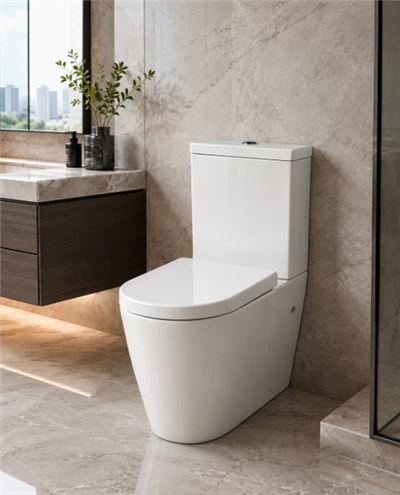
Floor-Mounted Toilets The FTZ-0420D is a compact two-piece dual flush toilet at 680mm length, suited to tighter bathroom footprints common in budget hotel renovations. Available in White and Biscuit. → View FTZ-0420D product page
The FTO-8848 is a standard two-piece dual flush toilet at 720mm length with 360-degree full-bore trapway glazing, suited to mid-market hotel specifications. → https://www.hfybath.com/toilet/two-piece-toilet/compact-two-piece-toilet-for-contractor.html
Wall-Mounted Basins → View basin range
Grab Bars & Toilet Safety Rails → View grab bar range