Why High-Turnover Rentals Break the Usual Spec Logic
Australian renovation and trade buyers already treat WELS ratings as a filter rather than the whole answer - what they worry about is flush reliability, parts availability, and set-outs that were guessed instead of measured, which surfaces as rework after tiling (westernbathroomrenovations.com.au, 2026-05). The selection logic below is built around exactly those three worries.
Selection Logic: Cleaning Time, Water, and a Body That Survives Commercial Cleaners
One wipe-down surface
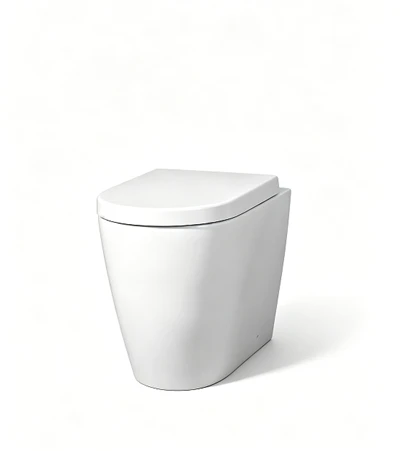
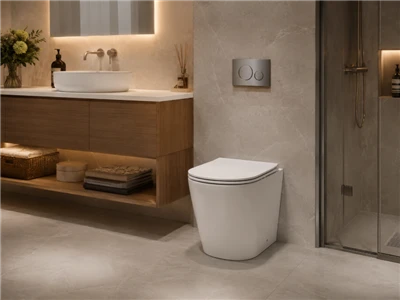
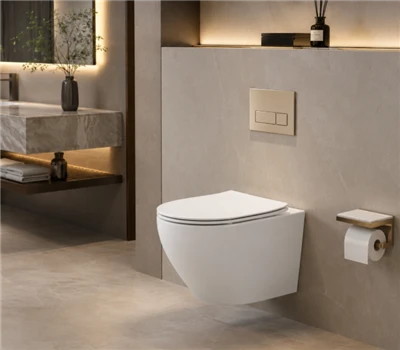
A full wall faced pan sits hard against the finished wall - no gap behind it, no exposed trap. If the skirted shape saves a cleaner even 30 seconds per bathroom, that is 15 minutes back per thirty-bathroom shift, every shift, for the life of the building. That arithmetic, not the showroom photo, is what the design earns you..
Water you can put a certified number on
Look for a WELS 4-star registration you can check yourself. Our suite carries Licence No. 1700: 4.6L full flush, 3L half flush, 3.2L average - figures you can confirm on waterrating.gov.au in about five minutes. For comparison, older 6/3L dual flush suites test to an average of 3.5–4.1L under the same AS 1172.2 discharge bands, so a 4-star suite trims roughly 0.3–0.9 litres from every flush, in every room, every day the building operates.
A ceramic body that shrugs off the chemicals
Third-party testing on our pan (Report A19014) measured water absorption at an average of 0.03% against the 0.50% ceiling in AS 1976 - a denser body that resists staining - and recorded no change against six cleaning agents including hydrochloric acid and sodium hydroxide. The pan also carried a 400kg load for 60 minutes without cracking. In rental stock, those are the numbers that decide whether year five looks like year one.
Three Procurement Mistakes That Cost Projects Money
1. Guessing the set-out instead of measuring from the finished wall.
When building A runs S-trap and building B runs P-trap - or the set-out was taken from the frame before tiling - the wrong pan arrives after the walls are finished. Two fixes: measure from the finished wall at tender stage, or specify a toilet back to wall with a universal trap so the same SKU lands either way.
2. Taking a "WaterMark certified toilet" claim at face value.
WaterMark applies to the flushing components - on our suite, inlet valve A1420 and outlet valve A2415 under Licence WMKA20080 - not to the whole ceramic. The water-efficiency claim lives in the WELS registry, under a licence number you can search. Trade guidance now is to request WELS and compliance documents at order time, not at delivery
3. Ordering the exact room count with no attic stock.
Ceramic breaks - in transit, in the lift, on the trolley. Our transit breakage runs below 0.5%, but a single broken pan on a 35–45 day resupply lead time can hold up a floor handover. Our recommendation: add roughly 2% attic stock to the order, and standardise on one model so one spare seat and one valve kit cover the whole portfolio.
The Combination We Recommend for Rental Portfolios
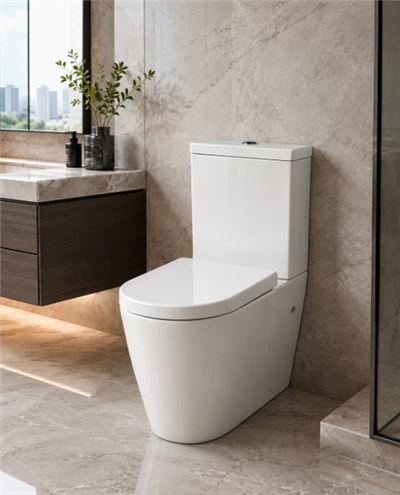
For the standard guest bathroom, our workhorse is the full wall faced close coupled suite (Model I05B2): universal S/P-trap, rear or bottom water entry, WELS 4-star under Licence 1700, 660 × 360 × 830mm. The flush valves are standard R&T components, which means replacement parts are off-the-shelf items years after handover rather than a proprietary hunt. OEM support covers your carton artwork and logo, so multi-site operators can label stock by property from day one.
Standardising one model across a portfolio is itself the combination: one seat SKU, one valve kit, one set of installation instructions for every contractor on every site. Mixed models are how spare-parts cupboards turn into museums.
Bulk Ordering Without Getting Caught Short
MOQ is 50 sets and production lead time runs 35–45 days; chargeable samples take 45 days. Batch units come off the same line, through the same kiln, and every single unit is water-tested before packing - sample-to-batch consistency is a process, not a promise. Suites ship in 5-ply corrugated cartons, palletised or timber-crated on request, and 20GP/40HQ loading quantities are confirmed with your quotation. If the fit-out is staged across buildings, put delivery dates on the table at order time - recent trade guidance says the same (robertson.co.nz, 2026-07) - and we confirm whether the schedule holds before you commit.

FAQ
Q: Can one toilet back to wall model cover both S-trap and P-trap buildings?
A: Yes, if the pan is universal-trap - Model I05B2 takes S-trap and P-trap set-outs with rear or bottom water entry, so one SKU covers mixed plumbing across a portfolio. That removes the most expensive set-out mistake: discovering the trap mismatch after tiling.
Q: How do we verify the WELS rating before tender?
A: Search the licence number - ours is 1700 - on waterrating.gov.au. The public listing shows the registered flush volumes (4.6L full, 3L half, 3.2L average) and the star rating. If a supplier cannot give you a licence number to search, treat the rating claim as unverified.
Q: What should we allow for samples and lead time?
A: Samples are chargeable and take 45 days; production is 35–45 days after order confirmation at MOQ 50. For a staged fit-out, send the handover dates with the enquiry - scheduling is confirmed before you commit, not discovered after.
Q: What documentation ships with the order?
A: The third-party test report (A19014, covering AS 1172.1:2014, AS 1172.2:2014, AS 1976-1992 and AS/NZS 6400:2016), WELS licence details, and installation instructions for both S-trap and P-trap set-outs - enough for your compliance file without chasing paperwork after delivery.