What set-out actually measures (and where buyers get it wrong)
Set-out is the distance from the finished wall to the centre of the waste pipe. The detail that catches people: you measure to the centre of the pipe, not the edge - measuring to the edge is one of the most common errors, and on a 90mm outlet that error is enough to leave a pan sitting proud of the wall or fouling the outlet.
The two trap types are measured differently. For an S-trap, you measure horizontally from the finished wall to the centre of the floor outlet. For a P-trap, you measure vertically from the finished floor to the centre of the wall outlet. One more trap for renovators: measure from the finished tile face, not the skirting board - building up tile after you've measured shifts the real set-out and the pan no longer sits flush.
Australian set-outs are not uniform. New homes commonly fall in a 140–165mm band that suits most suites, but older housing stock runs anywhere from under 100mm to over 200mm - which is exactly where stock toilets stop fitting and the job gets expensive

What are the disadvantages of a close coupled toilet?
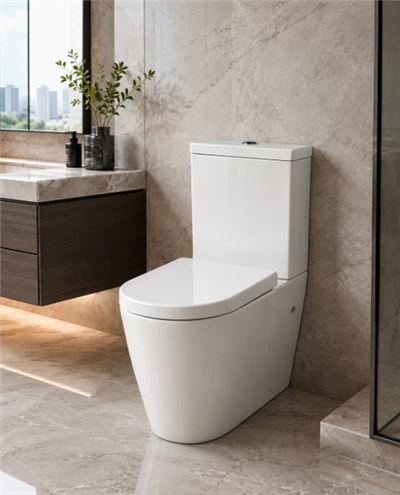
Direct answer: a close coupled toilet's main limitations are a visible cistern-on-pan profile (less streamlined than a back-to-wall or wall-hung suite) and a fixed projection, so it needs a set-out it can actually sit on. It is not a downside in performance - close coupled suites are the most common and most economical to install in Australia, with accessible parts your plumber already knows.
The practical catch for a buyer is projection. The Model 2005 has a 660mm depth - a standard-projection suite, not a compact pan - so on a tight powder room or a very short set-out you size it in deliberately rather than assuming it drops anywhere. That is a specification fact to put in front of your customer up front, not a surprise at install. The flip side: because the cistern sits on the pan and the flush is a conventional dual-flush washdown, there is no proprietary in-wall frame or concealed cartridge to source years later for a warranty call - which is why it stays the default line for rentals, project fit-outs and volume renovation.
What a set-out mismatch costs on site in 2026
This is the number that should drive your purchasing, because it is the cost your customer absorbs when the wrong trap turns up:
A like-for-like swap - same trap, same set-out - is routine: about one to two hours for a licensed plumber. (myhomeware.com.au, 2026-05.)
Change the outlet type or move the waste and labour jumps 30–40% on the install. (plumberoo / plumberooplumbing.com.au, 2026-04.)
A full trap conversion - coring a slab for an S-trap, or opening a wall and running new pipe with correct fall for a P-trap - runs roughly $800–$2,000 depending on access. (myhomeware.com.au, 2026-04.)
And the line every Australian plumbing source keeps repeating: set-out mismatch causes more failed toilet swaps than any other spec on the box. (plumberooplumbing.com.au, 2026-06.) For an online or bulk order that is a return - freight back, restocking, a ceramic unit that may not survive the round trip - not just a site delay.

Which toilets do plumbers prefer?
Direct answer: plumbers prefer a suite that matches the existing set-out so the job stays a like-for-like swap, carries WaterMark certification (which they check before installing), and uses standard, serviceable parts. Trap configuration that fits the rough-in beats brand or styling every time - a beautiful wall-faced pan is useless if the outlet is in the floor and the model only suits a wall outlet.
There is also a code dimension worth knowing as a buyer. The National Construction Code and current Australian standards now favour the P-trap, and some councils no longer accept a new S-trap install without additional venting - plumbers have had to fit an air admittance valve just to bring an S-trap up to code. (myhomeware.com.au, 2026-04.) That does not make S-traps obsolete - millions of Australian homes run them, and a properly vented S-trap is fine - but it is why a renovation buyer wants the option of either configuration on hand rather than being locked to one.
How dual S/P-trap availability removes the risk at the order stage
The cleanest way to kill set-out returns is to not gamble on which outlet the next job has. The WELS 4-star close coupled toilet (Model 2005) is available in both an S-trap (250mm set-out) and a P-trap (180mm set-out) configuration - one model, both rough-ins. For a distributor that means fewer SKUs to carry while still matching more bathrooms; for a renovation contractor it means you can commit to a suite before you have lifted every old pan, knowing the matching configuration exists.
Order to the existing rough-in: S-trap for a 250mm set-out, P-trap for a 180mm set-out.
Both configurations are WELS 4-star and WaterMark certified - compliant to sell and pass inspection in Australia.
Standard dual-flush washdown - serviceable parts, no proprietary frame to chase for warranty.
Practical buying checklist before you place a bulk order: confirm the trap type on each job, record the set-out to the centre of the pipe from the finished tile, and split your order quantity across S and P to match your actual job mix rather than guessing one ratio for everything.
FAQ
Q: Can I switch a toilet from S-trap to P-trap?
A: Yes, but it is licensed plumbing work, not a swap. Going S-to-P means running the waste out through the wall with correct fall; P-to-S means coring the floor. Budget roughly $800–$2,000 depending on access (myhomeware.com.au, 2026-04). It is most economical done during a full renovation when the plumbing is already open.
Q: Will an adjustable connector fix a set-out mismatch?
A: Sometimes, within a limited range. A licensed plumber can fit a pan connector to bridge a modest gap, but it has to be watertight and gas-tight, and it does not rescue a wall-vs-floor outlet difference. For volume buyers, matching the trap at order stage is cheaper and lower-risk than relying on connectors on site.
Q: What set-out does the Model 2005 need?
A: S-trap configuration suits a 250mm set-out; P-trap configuration suits a 180mm set-out. Measure your existing rough-in to the centre of the pipe and order the matching configuration.
Q: Is an S-trap still allowed in Australia?
A: Yes. S-traps are legal and common, but current standards favour P-traps and some councils require additional venting on a new S-trap install (myhomeware.com.au, 2026-04). A properly vented S-trap suite performs fine.