Step 1: Confirm WaterMark and WELS Before Anything Else
In Australia a toilet that is not WaterMark certified cannot legally be installed - a licensed plumber will not connect it, and they must issue a compliance certificate on completion. Separately, the product must hold a current WELS registration, and the dual-flush must deliver 4.5L full / 3L half. These are two different checks, and a pan that holds one but not the other still fails. So before you compare looks or price, get the certificate numbers in writing.
This is also where a new supplier earns trust. Ask for the actual WaterMark and 4-star WELS certificate numbers, not a line in a brochure. The Model 3060, for example, genuinely holds both and is built to AS 1172.1 / AS 1172.2 - the kind of detail you want documented for your compliance file, ready at inspection rather than scrambled for afterward.
Step 2: Match the Set-Out to the Site
Set-out - the rough-in distance to the waste outlet - is where most project pain starts. In Australian guidance the P-trap (wall outlet) set-out is typically around 180–185mm, and getting it wrong is described bluntly as an expensive mistake: the pan will not connect to the existing waste without offset connectors that hurt flush performance, or replumbing. One Australian bathware retailer reports that roughly 40% of toilet returns come down to dimension planning errors - set-out mismatch, projection overshoot, or clearance - with the cost of getting it wrong running anywhere from about A$150 in return freight to A$2,500 for a full replumb.
The practical move: confirm the pan's trap against your site before you commit volume. The 3060 runs a P-trap at 180mm rough-in to match standard Australian in-wall cistern outlets, so it lands on the common frames sold here - but you still check it against your own outlets. On a multi-unit job where set-outs vary floor to floor, that one check saves specifying two SKUs.
Step 3: Plan the In-Wall Frame and the Wall Itself
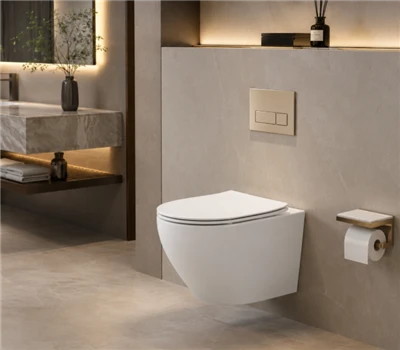
A wall hung toilet does not hang from the wall sheet - it hangs from a concealed steel frame that transfers the load to the floor. That frame is the part a project buyer has to plan around, and the single biggest reason wall-hung jobs go wrong is treating it as an afterthought. Australian fixture guidance is direct that the type chosen late causes problems: the wall framing, cistern space and rough-in all have to be planned before construction, not discovered on site.
Two things to confirm with your plumber early: the wall has the depth to house the frame and cistern once finishes are added (a thin partition often does not), and the frame is rated and fixed for the load. A correctly fixed frame is rated to carry a seated adult - typically around 400kg static - and is anchored to the floor, braced to the wall. Spec the pan and a matched frame together so the outlet, hole positions and finished height all agree; sourcing pan and frame from two suppliers that do not line up at the outlet is a common, avoidable headache.
Wall Hung Toilet Questions Buyers Ask (and Honest Answers)
These are the questions that come up on every wall-hung enquiry - from buyers and from the customers they sell to. Worth answering straight, because a distributor who can answer them closes faster
Honest Answers
These are the questions that come up on every wall-hung enquiry - from buyers and from the customers they sell to. Worth answering straight, because a distributor who can answer them closes faster
What are the disadvantages of a wall hung toilet?
We will be honest, because pretending there are none costs you credibility. The real disadvantages are cost and complexity, not the pan itself. A wall-hung setup needs an in-wall frame and a wall cavity to hide the cistern, so it costs more to buy and more to install than a floor-standing suite, and the install is a planned, pro-level job rather than a swap. Servicing the concealed cistern happens through the flush-plate opening, which is straightforward on modern systems but is a step a floor cistern does not need. And a thin existing wall may need building out to take the frame. None of these is a deal-breaker on a new build or full renovation - where the cavity is planned anyway - but they are real costs to weigh on a like-for-like swap.
01
Is a wall mounted toilet a good idea?
For the right project, yes. A wall mounted toilet frees the floor, so a compact ensuite or apartment bathroom reads larger and the floor cleans easily - which is why wall-hung pans show up in a reported 45% of high-end projects versus about 15% of general residential installs. It is a good idea where space is tight, the look matters, and the wall and frame are planned for. It is a weaker idea as a quick swap into an old solid wall with a fixed waste stack, where the work to retrofit can outweigh the benefit. Match the product to the job, not the trend.
02
How are wall hung toilets installed?
In sequence: the concealed frame is fixed first - anchored to the floor and braced inside the wall cavity - with the cistern and the waste outlet set to the rough-in height. The water supply and 180mm waste are connected and pressure-tested before the wall is closed (closing it first is a classic mistake). The wall is then sheeted and finished over the frame, leaving the flush-plate opening for access. Finally the pan bolts onto the frame studs. Because the load goes into the frame and floor, the finished wall stays clean. This is licensed-plumber work in Australia, not a DIY job.
03
Can in-wall toilets be installed on any wall?
Not on any wall as-is, but on most walls with the right frame. A concealed frame carries the load to the floor, so a wall-hung pan can go on a plasterboard stud wall provided the frame is fitted and the wall has the depth; on solid masonry the frame mounts to the brickwork. What it cannot do is bolt straight to a plasterboard sheet with no frame, and a thin partition may need building out to house the frame and cistern. Confirm the wall type and depth at design stage - that is the check that keeps the project on schedule.
04
A Quick Pre-Order Checklist
Before you commit volume on any wall hung pan for an Australian project, confirm:
|
Check |
Why it matters |
|
Current WaterMark + 4-star WELS certificate numbers |
Both are mandatory and separate; a plumber will not install without WaterMark, and WELS must be current to supply legally. |
|
P-trap set-out matches your outlets (3060 = 180mm) |
Set-out mismatch is the top cause of returns and replumb cost; one check avoids two SKUs across a build. |
|
Wall depth + frame rating for the wall type |
The frame carries the load (~400kg static) to the floor; a thin wall may need building out - plan at design stage. |
|
Pan and frame quoted as a matched set |
Avoids the outlet/hole-position mismatch that comes from sourcing pan and frame separately. |
|
MOQ and lead time fit your rollout |
A low MOQ lets you trial on one stage; confirm lead time against your build program. |