The US Market Price Tiers - What's in Each Band
TIER 1: $350–$650 RETAIL (TOTO, DURAVIT, UPPER KOHLER)
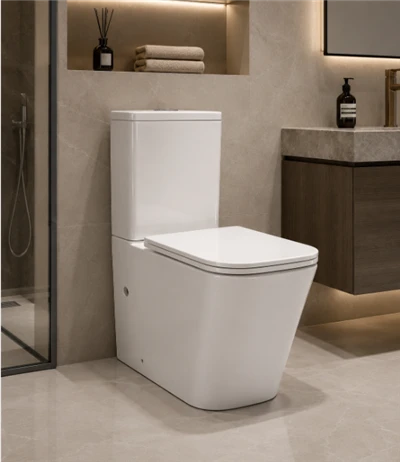
TOTO's Aquia IV, one of the most recognized two-piece dual flush toilets in this tier, features CeFiONtect ceramic glaze, which creates a smooth ion-barrier surface designed to prevent particles from adhering to the ceramic. It also includes the brand's DynaMax Tornado Flush system, which uses 360-degree cleaning to reach every part of the bowl.
What you are paying for at this tier:
Proprietary glaze technology - TOTO's CeFiONtect and Kohler's equivalents are genuinely engineered surface treatments, not marketing language. They reduce cleaning frequency, which matters in hospitality settings.
Brand pull-through - Your end customer or their designer may specify TOTO by name. That demand is real and it commands a price.
Retail margin stack - By the time a toilet reaches a Home Depot shelf at $400+, it has passed through importer, distributor, and retailer margins. None of that adds to the ceramic specification.
For wholesale buyers: If your project requires TOTO by spec, you buy TOTO. If your project requires a dual flush toilet that meets UPC, clears the bowl, and fits a 305mm rough-in, you are paying for brand equity you cannot pass on to a project invoice.
TIER 2: $200–$350 RETAIL (AMERICAN STANDARD H2OPTION, MID-RANGE KOHLER)
American Standard's H2Option uses siphon jet bowl technology with a PowerWash rim and carries WaterSense certification, with dual flush volumes of 1.28 GPF and 0.92 GPF. The chair-height version includes a slow-close seat, chrome push-button actuator, color-matched bolt caps, and a wax ring - a complete install package at the retail price point.
What you are paying for here:
Established distribution network - American Standard products are stocked nationwide, which means your contractor customers can get replacement parts locally.
WaterSense certification - Covers state-level compliance requirements in California, Texas, Colorado, and others without additional documentation work.
Moderate brand recognition - Contractors know the name. It sells without explanation.
For wholesale buyers: This tier makes sense if you are supplying single-unit replacements to contractors who need walk-in availability. For project orders of 30 units or more, the per-unit cost and the inability to negotiate pricing or OEM packaging are real limitations.
TIER 3: $100–$200 RETAIL (STORE BRANDS, VALUE IMPORTS)
This tier covers a wide range of quality. Some products in this band are manufactured in the same factories as Tier 2 products and differ only in certification documentation and quality control protocols. Others are not.
What to verify at this tier before stocking:
Is the UPC or cUPC certification current and independently verifiable through IAPMO's online database?
Is the trapway fully glazed, or only partially? Partial glazing is a cost-cut that causes mineral buildup over 2–3 years in hard-water markets.
Is the fill valve a standard industry replacement part, or proprietary? Proprietary valves create after-sales dependency that generates distributor callbacks.
What is the actual flush volume consistency across 10 consecutive flushes - not just the first one?
The answer to those four questions tells you more about a product in this tier than the brand name does.
The Specification That Actually Separates Products - Not the Name
When you strip out brand premium and retail margin, two-piece dual flush toilets for the US market are differentiated by five factors that affect project outcomes:
Trapway glazing coverage
Full 360-degree internal glazing of the trapway and siphon jet channel is a production cost. It requires an additional manufacturing step. Factories that skip partial sections of the trapway glaze do so to reduce cost. In hard-water markets - which covers most of the western US - partial glazing means mineral deposits accumulate and gradually narrow the trapway, leading to incomplete flushes 18–24 months after installation. This is the single most common source of callbacks on lower-cost toilets.
01
Fill valve standardization
An industry-standard fill valve (Fluidmaster 400A or equivalent) can be sourced at any plumbing supply house in the US for under $15. A proprietary fill valve requires ordering from the original supplier, often with a 2–4 week wait. For a property manager with 80 units on one toilet model, fill valve standardization is a maintenance cost decision, not a feature preference.
02
Flush volume consistency across the product run
A toilet that delivers 1.28 GPF on the factory test bench should deliver 1.28 GPF on the 200th unit in a container, and after 3 years of use. Consistency across a production batch is a function of kiln temperature control during firing - specifically, cross-section temperature uniformity across the firing zone. Factories with tunnel kilns running tight temperature tolerances produce more consistent ceramic density, which affects flush performance over the product lifespan.
03
S-trap versus P-trap configuration For US residential and apartment renovation projects, S-trap floor outlet is the standard configuration. P-trap (wall outlet) is used in different markets. Getting this wrong on a 100-unit order means 100 units that cannot be installed without floor modification. Confirm before ordering - it is not always obvious from photos.
04
Rough-in measurement accuracy The 305mm / 12-inch rough-in is the North American residential standard. Manufacturing tolerance on this dimension matters: a toilet that is 8mm off-spec will sit visibly away from the wall. Verify the rough-in on the actual sample unit with a tape measure, not just the spec sheet.
05
What Factory-Direct Sourcing Changes for Project Buyers
The retail price tiers above reflect the full distribution chain: Chinese or Mexican manufacturer → US importer → regional distributor → retailer → end customer. Each step adds margin. None adds to the ceramic specification.
For project buyers ordering 20 units or more, factory-direct sourcing from a certified manufacturer removes two to three layers of that margin stack. The ceramic going into a $380 retail TOTO and a $XX factory-direct unit from a UPC/CSA-certified Tangshan manufacturer is vitreous china fired at high temperature. The specification difference at the ceramic level is smaller than the price difference suggests.
What factory-direct sourcing does require from a buyer:
Certification verification - Do not accept a claim of UPC certification. Ask for the certificate number and verify it in IAPMO's online database. A legitimate manufacturer can provide this in 24 hours.
Pre-shipment inspection - For orders above 50 units, a third-party inspection (SGS or Bureau Veritas) covering dimensional tolerances, glaze inspection, and flush performance on 10% of units is standard practice and worth the cost.
Lead time planning - Factory-direct orders run 35–45 days from deposit to container loading. That requires more planning than pulling stock from a US distributor's warehouse, but it is manageable for project procurement.
Sample evaluation - Order one unit before committing to volume. Test it properly: flush it ten times, measure the rough-in yourself, check the seat mechanism 50 times.
The Practical Decision Framework for Wholesale Buyers
|
Situation |
Recommended approach |
|
Project specifies brand by name |
Buy that brand - the spec is the spec |
|
1–5 unit replacement order, need immediate availability |
Buy from US distributor stock |
|
20–500 unit project, no brand specification |
Evaluate factory-direct with UPC/CSA documentation |
|
OEM private label program |
Factory-direct only - no retail brand will OEM |
|
Biscuit color required, tight budget |
Verify factory can supply - most retail brands charge premium for non-white |
|
Tight bathroom footprint (under 690mm depth) |
Confirm product dimensions - many standard models run 700mm+ |
Questions to Ask Any Supplier Before Placing a Project Order

These apply whether you are buying from a US distributor or direct from a factory:
Can you provide the UPC/CSA certificate number for independent verification through IAPMO?
Is the trapway glazing full 360-degree bore, and can you show the production specification document?
What fill valve standard does the product use - industry-standard replacement or proprietary?
What is the flush volume tolerance across a production run - and how is that controlled at the kiln?
What does your pre-shipment inspection process cover, and do you accommodate third-party inspection?
Any supplier - US distributor or Chinese factory - that cannot answer these questions has not thought carefully about the product they are selling.
A Note on the FTZ-0420D
If you are evaluating a compact two-piece dual flush toilet for US apartment renovation, rental property standardization, or budget hotel refurbishment, the FTZ-0420D from HFY Bath is worth a sample order. It is a 680mm floor-mounted siphonic toilet with 305mm S-trap rough-in, 0.8/1.6 GPF dual flush, slow-close seat included, and available in White or Biscuit. UPC, CSA, CE, and ISO 9001 certified. MOQ 20 units, 35–45 day lead time, OEM available.
We are not the right supplier for single-unit replacements or projects that specify a brand by name. For project procurement at volume, we are worth the conversation.
https://www.hfybath.com/toilet/two-piece-toilet/compact-two-piece-toilet-for-contractor.html