How the Siphonic Flush Mechanism Actually Works

The term 'siphonic' gets used loosely, so it is worth being precise. A siphonic toilet does not rely purely on gravity - it creates a vacuum in the trapway during the flush cycle that actively draws waste and water out of the bowl. The sequence is:
Water enters the bowl simultaneously through the rim jets and a dedicated siphon jet channel positioned at the base of the bowl.
The siphon jet directs a concentrated stream of water into the top of the trapway opening, rapidly filling the S-shaped passage.
Once the trapway is full, air cannot enter from the drain side, creating a low-pressure zone - the siphon - that pulls the bowl contents through.
The siphon collapses when air enters the trapway after the bowl empties, producing the familiar gurgling sound at the end of the flush.
This mechanism produces a quieter, more thorough flush compared to washdown or direct-flush systems. The vacuum action cleans the bowl walls on the way out, not just the bottom, which is why siphonic toilets consistently outperform washdown models in long-term cleanliness assessments.
Technical note - trapway diameter and glazing
The siphon requires a narrow enough trapway to maintain vacuum pressure but wide enough to pass solid waste without blockage. The standard residential trapway in a siphonic toilet runs 41–52mm (1.6–2 inches) in diameter. The glazing on the interior surface of the trapway matters considerably: partial glazing creates microscopic rough surfaces where mineral deposits accumulate, gradually narrowing the passage. Full 360° glazing maintains a smoother bore over the product lifespan and is particularly relevant in hard-water markets.
Products DescriptionSiphonic vs. Gravity Flush vs. Washdown: Comparison for Wholesale Buyers
The three most common toilet flush systems you will encounter when sourcing from China are siphonic, gravity (washdown is a subset), and pressure-assisted. Pressure-assisted is rarely relevant for residential wholesale at scale due to cost and maintenance complexity, so the practical choice is usually between siphonic and washdown.
|
Factor |
Siphonic Dual Flush |
Washdown / Gravity |
|
Flush noise |
Low - vacuum action is quieter |
Higher - water-driven impact is audible |
|
Bowl cleanliness |
High - rim jets + siphon pull clean walls |
Moderate - relies on water volume |
|
Water per flush |
1.0 / 1.28 GPF (dual) |
0.8–1.6 GPF depending on model |
|
Clog risk |
Moderate - narrow trapway |
Lower - wider, straighter drain |
|
Hard water performance |
Better with full-glaze trapway |
Less affected by mineral buildup |
|
North America compliance |
Standard - UPC/CSA readily available |
Available but less common in NA market |
|
End-user complaints |
Rare when properly specified |
Occasional dual-flush inconsistency |
|
Best application |
Residential, hospitality, mid-rise |
Commercial high-traffic, water-scarce regions |
For the North American market specifically, siphonic is the default architecture. The UPC (Uniform Plumbing Code) and its Canadian equivalent were both written around siphonic performance characteristics. When specifying toilets for US or Canadian projects, you will encounter significantly fewer compliance questions with a siphonic model than with a washdown configuration.
Understanding Dual Flush in Practice - 1.0 GPF vs 1.28 GPF
What the numbers mean
The 1.0 GPF partial flush (liquid waste only) and 1.28 GPF full flush (solid waste) on a siphonic toilet are achieved by controlling the volume of water released from the tank. On most dual flush cisterns, two separate buttons or a split button releases either a partial or full tank volume. The critical issue in manufacturing is consistency: a toilet that delivers 1.28 GPF at the factory test station should deliver 1.28 GPF on the 300th unit in a container and after 5 years of use.
WaterSense compliance and state-level requirements
The EPA WaterSense program requires a maximum of 1.28 GPF for the full flush on certified toilets. This matters for your wholesale business in two ways:
WaterSense certification is required for rebate eligibility in many US municipalities - buyers who want to access water utility rebates for their customers need WaterSense-compliant products.
Several states have enacted plumbing codes that require 1.28 GPF or lower as a baseline for new construction and renovation. California (Title 20), Colorado, Georgia, and Texas all have active water efficiency standards that apply at the point of installation.
The dual flush complaint pattern - and how to avoid it
The most common field complaint on dual flush toilets across all price points is not flushing failure - it is inconsistency. The half-flush button clears the bowl on the first use, then does not on the third use two weeks later. This is almost always a fill valve calibration issue rather than a design flaw, and it is more common in markets with variable water pressure.
What to look for when evaluating a factory sample:
Test the partial flush five times consecutively with a 2-minute refill interval between flushes. It should perform identically each time.
Test with the building's actual water pressure if possible, or at both 20 psi and 80 psi if you have pressure regulation available. The UPC requires performance across a range.
Check whether the fill valve is a proprietary component or an industry-standard replacement. Proprietary fill valves create after-sales dependency - standard valves mean your end customers can get replacements locally.
The 12-Inch Rough-In Standard - Why It Matters for North American Projects
The rough-in measurement is the distance from the finished wall behind the toilet to the center of the floor drain outlet. In North American residential construction, 12 inches (305mm) has been the near-universal standard since the mid-20th century. Most toilets manufactured for the US and Canadian markets are designed around 12-inch rough-in.
Where distributors run into problems:
Older homes (pre-1960) occasionally have 10-inch rough-in. Supplying a 12-inch toilet into a 10-inch rough-in will result in the toilet sitting away from the wall, which is both aesthetically unacceptable and potentially a code violation.
Some new construction in dense urban markets uses 10-inch rough-in to allow wall-to-wall installation. Always confirm rough-in before supplying for new build projects.
S-trap floor outlet configuration (as used in the FTO-8848) fits the standard floor flange used across North American residential construction. This is not a limitation - it is the standard configuration.
|
Practical note for your sales team Train your sales team to ask for rough-in confirmation on every project order, not just new builds. A contractor refitting 80 units in a 1940s building who gets the wrong rough-in will not just return the units - they will not order from you again. One qualifying question saves the relationship. |
Certifications That Actually Matter for US and Canada
UPC / cUPC (Uniform Plumbing Code)
The UPC is administered by IAPMO (International Association of Plumbing and Mechanical Officials) and is the dominant plumbing code in the western United States. cUPC extends the same certification to the Canadian market. UPC certification verifies that the toilet meets specified performance thresholds for flush volume, trapway diameter, and bowl evacuation. It is the baseline requirement for products destined for most US residential and commercial projects.
CSA (Canadian Standards Association)
CSA certification is the Canadian equivalent, administered by CSA Group. For products sold into Canada, CSA is the relevant mark. Some buyers assume that UPC covers Canada - it does not independently. cUPC is the combined mark, or you need separate UPC and CSA certificates.
WaterSense
WaterSense is an EPA program, not a regulatory requirement at the federal level, but it functions as a de facto requirement in an increasing number of state and municipal codes. It also opens eligibility for water utility rebate programs, which your retail and contractor customers may actively need.
What to verify before ordering
Ask for the actual certificate documents, not just a claim that a product is certified.
Verify the certificate is current - IAPMO and CSA Group maintain searchable online databases.
Confirm the certificate covers the specific model number you are ordering, not just a product line.
For projects requiring ADA compliance, confirm bowl height (17–19 inches for comfort height / ADA) separately - UPC certification does not cover ADA requirements.
Products DescriptionWhat to Look for When Evaluating a Factory Sample
Most distributors evaluate toilet samples visually and with a single flush test. That is not sufficient for making a sourcing decision on a product you are going to put your reputation behind. Here is a more systematic approach.
Glazing inspection
Fill the bowl with water and observe the waterline. A full-glaze bowl will have a consistent, even sheen across the entire internal surface, including the trapway entrance. Any matte or chalky patches indicate unglazed ceramic. Run your finger along the trapway entrance if you can reach it - smooth is glazed, slightly rough is not.
Flush consistency test
Flush the sample ten times. Not twice, not three times - ten times. Use a measuring jug to confirm flush volume is consistent. Check that the bowl clears completely on every flush, not just the first five. A fill valve that is not properly calibrated will often perform correctly when full but drift after repeated cycles.
Dimensional verification
Measure the rough-in distance yourself with a tape measure. Do not rely on the spec sheet for the specific unit you are evaluating. Measure the trapway outlet diameter. Check the seat height with a level. These three measurements are the ones most likely to cause field problems if they are off.
Seat and hardware quality
The slow-close seat mechanism is the component most likely to generate customer complaints. Open and close it 50 times quickly. It should slow-close consistently on every cycle, with no sticking, no rattle at the hinge, and no play in the attachment point. Cheap hinge plastics crack within months of regular use.
Where Siphonic Dual Flush Toilets Perform Well - and Where They Do Not
product key technologies

Good fit
Mid-rise apartment renovation (50–300 units): Consistent siphonic performance handles variable water pressure across floors; 12-inch rough-in fits existing infrastructure; dual flush meets water efficiency codes.
Hotel and motel refurbishment (budget to mid-market): Low flush noise is valued by guests; full-glaze trapway reduces maintenance calls; OEM branding options allow property-specific customization.
Residential distribution to contractors and builders merchants: WaterSense compliance covers state requirements; 5-year warranty reduces warranty administration burden; standard rough-in means one SKU covers the majority of replacement jobs.
Rental property management companies: Standardizing on one model across a portfolio simplifies parts inventory and maintenance training.
Not a good fit
High-traffic commercial washrooms (airports, stadiums, office buildings): Pressure-assisted or washdown systems are better suited to very high flush frequency and commercial-grade maintenance schedules.
Installations below the sewer line (basements without ejector pumps): Siphonic relies on gravity-assisted drainage - macerating or upflush systems are required for below-grade applications.
Projects specifying ADA comfort height (17–19 inch bowl): Confirm seat height on any model before ordering - not all siphonic dual flush models meet ADA height requirements.
Markets with chronic low water pressure (below 15 psi): The siphon formation requires adequate inlet pressure. Very low pressure systems produce slow, incomplete flushes.

Sourcing From China: What the Factory Setup Tells You
When you are evaluating a ceramic toilet manufacturer in China, the factory infrastructure gives you more information than any sales presentation. Two things matter most for toilet manufacturing quality: the kiln setup and the glazing process.
Kiln type and capacity
Tunnel kilns - the standard in serious-scale ceramic production - fire product continuously on a conveyor through a controlled temperature gradient. The cross-section temperature uniformity of a tunnel kiln determines whether every unit in a batch fires to the same specification. A 126-meter kiln firing at 3.2 meters wide can maintain tighter tolerances than a smaller or older kiln, simply because the firing zone is large enough to avoid edge effects.
Ask your factory about kiln dimensions and temperature logging per batch. A factory that monitors and logs kiln cross-section temperatures is one that catches batch-level variation before it ships. One that cannot answer this question has not thought carefully about consistency.
Glazing process
Full 360° internal glazing of the trapway and siphon jet channel is a production cost - it requires an additional glazing step and careful handling. Factories that skip partial sections of the trapway glaze do so to reduce cost. Ask specifically whether the trapway glazing is full-bore or partial, and ask to see the production specification document, not just a verbal answer.
Pre-shipment inspection
For any order above 50 units, a pre-shipment inspection by a third-party inspector (SGS, Bureau Veritas, or similar) is worth the cost. The inspection should cover: dimensional tolerances on rough-in and trapway, surface glaze inspection on a sample, flush performance test on 10% of units, and seat mechanism check. A factory that resists pre-shipment inspection is a factory that has something to hide.
FTO-8848 Specifications at a Glance
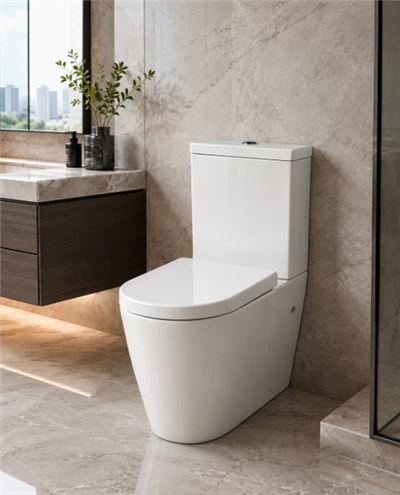
The following table summarises the key specifications of thehttps://www.hfybath.com/toilet/two-piece-toilet/two-piece-dual-flush-toilet-siphonic.html, the two-piece siphonic dual flush toilet this guide accompanies, for buyers who want to cross-reference against their project requirements.
|
Specification |
Detail |
|
Model |
FTO-8848 |
|
Configuration |
Two piece (separate tank and bowl) |
|
Flush system |
Siphonic jet |
|
Flush volume |
4.8L / 6L → 1.0 GPF / 1.28 GPF (dual flush) |
|
Rough-in |
305mm / 12 inch (North America standard) |
|
Trap type |
S-trap, floor outlet |
|
Trapway glazing |
360° full-pipe glazing, large-diameter bore |
|
Product size |
720 × 367 × 740mm (28.3" × 14.4" × 29.1") |
|
Seat height |
420mm / 16.5 inch (standard residential) |
|
Colors |
White / Biscuit |
|
Seat |
Slow-close included |
|
Certifications |
UPC · CSA · CE · ISO 9001 |
|
Warranty |
5 years (manufacturing defects) |
|
MOQ |
20 pcs |
|
OEM / ODM |
Available |
|
Origin |
Tangshan, China |
Questions to Ask Before You Place an Order
Regardless of which factory you are evaluating, these are the questions that separate a considered sourcing decision from one that relies on hope:
Can you provide current UPC and CSA certification documents, with the certificate number I can verify independently?
Is the trapway glazing full 360° bore, and can you show me the production spec document that confirms this?
What is your kiln cross-section temperature variance per batch, and do you log this data?
What fill valve standard do you use - proprietary or industry-standard replacement?
What does your pre-shipment inspection process cover, and do you accommodate third-party inspection?
What is your actual current production lead time from deposit to container loading?
For OEM orders, what is the minimum quantity, and what branding locations are available on the ceramic body?
What is the warranty claim process, and what documentation do I need to submit a claim?
These are not adversarial questions - any factory that has been exporting to the North American market seriously will answer all of them without hesitation. Hesitation is information.
https://www.hfybath.com/toilet/two-piece-toilet/two-piece-dual-flush-toilet-siphonic.html