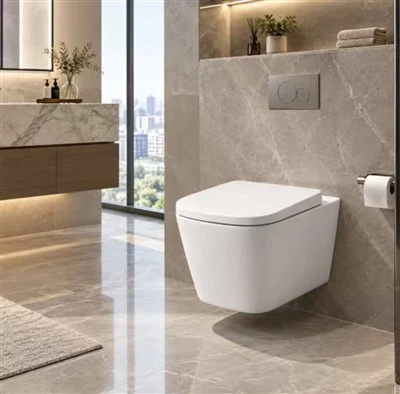
As a core component of modern sanitary facilities, toilet performance directly impacts user experience, public hygiene, and water resource efficiency.With technological advancements and growing environmental awareness, the evaluation of toilet performance has expanded beyond flushing functionality to encompass multiple dimensions, including water conservation, flushing effectiveness, quietness, durability, and intelligence. This article systematically explores the key elements of toilet performance and their optimization strategies from the perspectives of technical parameters, user experience, and industry standards.
Technical Definition of Core Performance Indicators
1. Flush Efficiency and Water Conservation
Flush efficiency is the primary indicator of toilet performance, typically measured by flush volume (L/flush). Traditional toilets typically use 6-9 liters of water per flush. Modern high-efficiency toilets, through optimized tank structures and siphon technology, can reduce water consumption to 3-4 liters. Some even offer dual-flush modes (e.g., a 3-liter half flush and a 6-liter full flush). Water conservation not only relies on water volume control but is also closely linked to flushing dynamics. For example, jet siphon toilets significantly improve waste removal efficiency by adding auxiliary flush holes.
2. Flushing Performance and Pipe Compatibility
Flushing performance depends on water flow velocity, vortex intensity, and glaze smoothness. High-quality toilets utilize a high-density ceramic glaze (surface roughness Ra < 0.2μm) combined with an S-shaped or U-shaped pipe design to reduce soiling and reduce clogging. International standards such as ISO 3866 clearly define "one-flush cleaning efficiency," requiring toilets to achieve 100% removal under standard test conditions (simulating 300g of clay waste).
3. Noise Control and User Comfort
Flushing noise primarily stems from tank decompression and water impact, typically ranging from 50-75dB. Quieting technologies include: an air-pressure-balanced tank (reduced water flow velocity), a sound-absorbing foam infill layer (sound absorption coefficient > 0.8), and a slow-drop cover (damping hinge design). Ultra-quiet toilets with a noise level of <50dB have become a critical requirement in medical and high-end residential settings.
Collaborative Optimization of Materials Science and Structural Design
1. Advanced Application of Ceramic Materials
Toilet bodies are often made of high-alumina ceramic (Al₂O₃ content ≥25%), whose thermal stability and mechanical strength directly impact their service life. Nano-glaze treatment can increase surface hydrophobicity by 30%. Combined with an antibacterial silver ion coating (e.g., Ag⁺ release ≥0.05mg/dm²·day), it effectively inhibits the growth of pathogens such as E. coli.
2. Innovative Water System Design
• Dual Siphon Technology: Through the synergistic action of the primary and secondary siphons, stable pressure is maintained even in low water pressure environments (above 0.08MPa).
• Optimized Deflector: Deflectors with a 15°-20° tilt angle increase water flow coverage to over 92%.
• Intelligent Pre-wetting: Some models automatically spray a small amount of water mist before flushing to reduce the likelihood of dirt sticking.
Trends in Intelligence and Sustainability
Modern high-end toilets are integrating multiple intelligent features:
•Contactless Control: Infrared sensor lid/flush (response time <0.3 seconds)
•Water Purification System: Built-in UV sterilization module (sterilization rate ≥ 99.9%) or activated carbon filter
•Energy Management: Electronic components with standby power consumption <0.5W and solar-assisted power supply
In terms of sustainability, the EU ErP Directive mandates that new toilets launched after 2025 must not exceed 4.5 liters of water for a full flush. China's "Limited Values and Water Efficiency Grades for Toilets" (GB 25502-2017) categorizes products into three energy efficiency levels: Level 1 (≤4.0L), Level 2 (≤5.0L), and Level 3 (≤6.4L).
Performance Verification and Standardization System
Internationally accepted testing methods include:
1.American Standard ASME A112.19.2: Mud filling test (simulating 60 standard dirt balls)
2.German DIN EN 997: Assessing material stability in environments between -10°C and 50°C
3.China JC/T 764-2008: Specifies seat durability testing (≥100,000 opening and closing cycles)
Consumers should focus on the following when purchasing:
•Water Efficiency Label Certification Number
•Mohs Hardness of Glaze (recommended ≥5)
•After-sales Service Response Time (critical seals generally have a warranty period of ≥5 years)
Conclusion
Optimizing toilet performance exemplifies the intersection of materials science, fluid dynamics, and ergonomics. Future development will focus on: AI-based adaptive flushing algorithms, tankless gravity-assisted systems, and the industrial application of biodegradable coating technology. Through continuous technological innovation, toilets are expected to be upgraded from basic sanitary appliances to key nodes in the smart home ecosystem.